
Tree Removal in Perry, GA
Quick answer
Inside Perry, Georgia, taking down a pine or a dead tree needs no city permit, but removing a live hardwood such as an oak or a pecan needs the city's $69.00 Tree Removal Permit before the saw starts (LMO Sec. 6-4.1(B); Fee Schedule Resol. 2025-60, adopted Oct 21, 2025; checked Nov 15, 2026). In the unincorporated parts of Houston County, the county's tree rules don't reach home lots that are already developed (Sec. 83.3), and anywhere in Perry the haul-away belongs in the contractor's price, because the city won't pick up tree-crew debris (City of Perry Solid Waste; both checked Nov 15, 2026).
Does it matter whether the tree is a pine or a hardwood?
In Perry it decides the paperwork. The city's tree rule is Sec. 6-4, "Tree Protection," in its Land Management Ordinance, and subsection 6-4.1(B) applies it to "all existing and new development." That wording matters: a house built in the 1970s is covered the same as a lot being cleared this year (LMO Sec. 6-4, revised through Aug 18, 2026; checked Nov 15, 2026).
The same subsection then lists what's exempt (checked Nov 15, 2026). Pines are, by name: "The removal of pine trees." So are dead trees and trees that fell on their own. On an ordinary home lot, nearly everything else that's alive, from a water oak to a pecan to a red maple, needs the Tree Removal Permit, and the bigger hardwoods carry extra conditions. Here is how one tree sorts out depending on which side of the city line it stands:
| The tree | Inside Perry city limits | Unincorporated Houston County | Inside Warner Robins |
|---|---|---|---|
| Pine, any size | No city permit (Sec. 6-4.1(B)(2)) | No county permit on a developed lot (Sec. 83.3) | No removal permit for a private home lot found in the city code, whose tree rules (Secs. 2-226 to 2-237) cover public and street trees; confirm at 478-293-1000 |
| Dead or naturally fallen | Exempt (Sec. 6-4.1(B)(1)) | No county permit on a developed lot | No private-lot permit found; Sec. 2-235 requires owners to remove dead or dangerous trees and limbs that threaten people on a street or sidewalk |
| Live oak, pecan, maple or other hardwood | $69.00 Tree Removal Permit; staff decide on replacement trees | No county permit on a developed lot | No private-lot permit found in the code |
| Hardwood about 20 in. or more across at 4.5 ft | Heritage tree: written approval, and two 4-inch replacement trees (four at 30 in.) | No county permit on a developed lot | No private-lot permit found in the code |
The pine exemption has one string attached. The code grants it "provided the minimum requirements of this section are maintained," which points back to the city's minimum number of shade trees per lot (below). As read on Nov 15, 2026, neither Sec. 6-4 nor the permit application says how staff apply that to a pine-only removal, so if the pines are most of what's growing on your lot, a call to Community Development at (478) 988-2720 settles it before the crew arrives. The full rule, with the application steps, is on the Perry permit page.
What will Perry's staff look at before the permit is issued?
The application asks for a written statement of why the tree is coming out and when, plus a sketch of the property marking every tree and the ones to be removed. After that, city staff come out and measure the tree to decide whether replacements are needed under Sec. 6-4.2(B) (Application for Tree Removal Permit, revised 7/1/2025; checked Nov 15, 2026).
The yardstick is a minimum tree count. Sec. 6-4.2(B)(2) says single-family and two-family lots must "provide or maintain one shade tree for each 3,000 square feet of lot area," with the house's footprint left out of the math, and an existing tree over 6 inches thick that's kept counts double. On a 15,000-square-foot lot with a 2,400-square-foot house, that works out to 12,600 square feet, or a bit over four shade trees' worth. Three kept trees over 6 inches thick would more than cover it, since each counts double. If taking a hardwood out drops the lot below its number, expect to plant. When replacements are required, the city notifies you so you can plan the planting and its timing, and staff inspect once the agreed period is up.
Size raises the stakes. A non-pine about 20 inches or more across at 4.5 feet off the ground is a heritage tree, and one about 30 inches or more is historic; removing one means two or four 4-inch caliper shade trees go back in. If the lot has no room for them, they can go on approved public land, or a payment goes into the City of Perry tree fund in their place, at an amount Community Development sets (LMO Sec. 6-4.2(C); checked Nov 15, 2026). The definitions in Sec. 1-13 add a setback condition, explained on the Perry permit page.
Which warning signs mean a tree near the house should come down?
UGA Extension's hazard-tree guidance lists the things worth worrying about in a yard tree (checked Nov 15, 2026):
- A narrow, V-shaped fork, or two trunks of about the same size squeezing bark between them where they meet.
- Mushrooms or shelf-like conks on the trunk or at the root flare, which mean decay inside. UGA's wording is blunt: "There is no cure for wood decay."
- A root plate that has shifted, or soil cracking on one side of the trunk.
- Old topping cuts, where the crown was sheared off flat at some point.
On hardwoods, UGA's oak disease key adds hypoxylon canker, which shows as bark sloughing away over hard, tan-to-silver-gray fungal mats on trees already stressed by heat or drought, and advises removing infected limbs or trees once they become a hazard to people or property (UGA Extension B1286; checked Nov 15, 2026). UGA's "Is My Tree Dying?" circular puts root trouble even more starkly: "Root decay is a sign that a tree is well into its death spiral" (C1100, reviewed April 2024).
Some species start out with the odds against them. UGA notes that Bradford pears are prone to split in wet, windy weather, and that willows, silver maples and Bradford and other edible pears tend to have weak, upright branching and often live only about 20 years. Perry agrees in its own way: its tree list bars Bradford and Callery pear from required plantings as "weak wood, invasive," and silver maple is on the same prohibited list (City of Perry tree list; checked Nov 15, 2026).
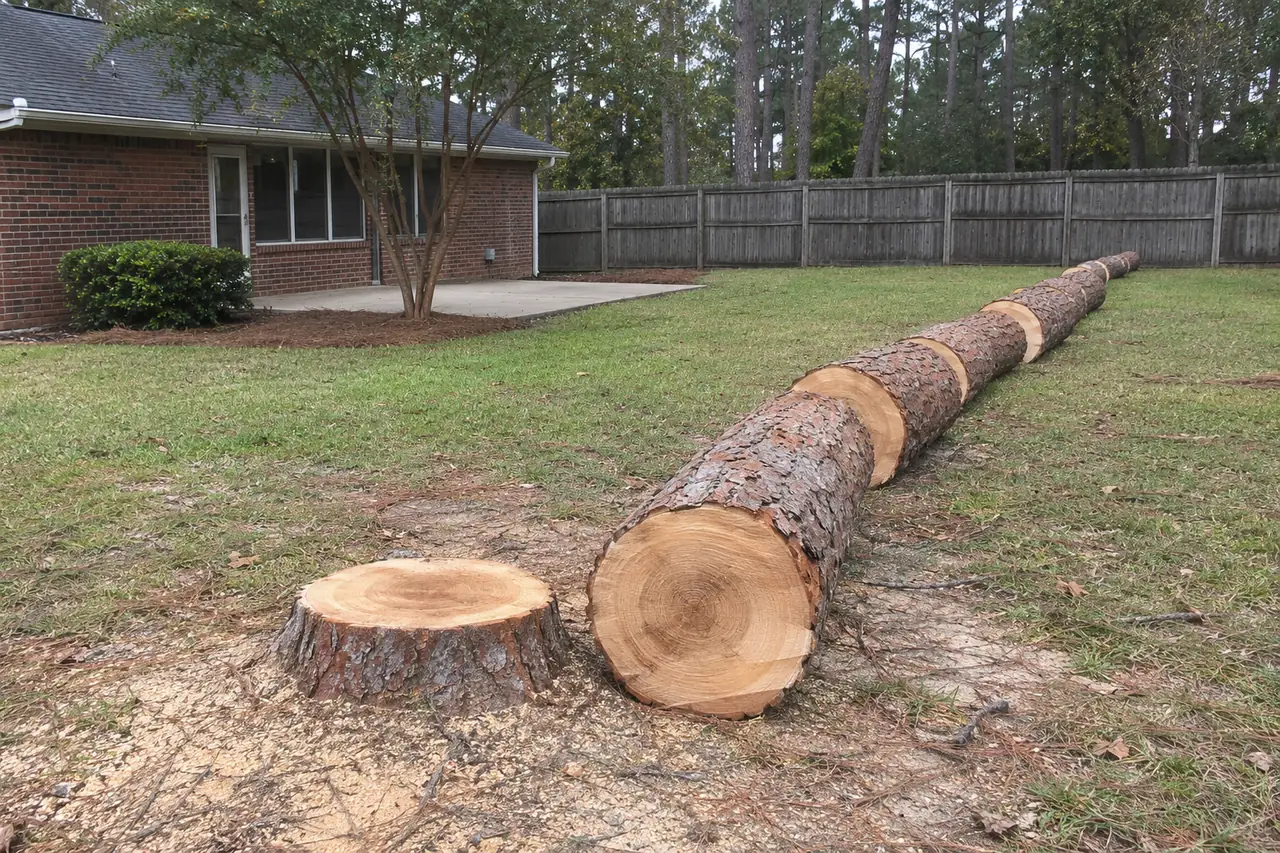
What does the ground around Perry do to a big tree?
Perry and Warner Robins sit on what Georgia's geologists call the Fort Valley Plateau, a flat to very gently rolling surface just south of the Fall Line at Macon. The state's geologic atlas describes it as capped by a reddish-brown, mostly clayey layer up to about 40 feet thick, lying over sand and sandy kaolin; one of the named sand units underneath is even called the Perry Sand, and a low scarp about four miles south of town is the Perry Scarp (Georgia Geologic Survey Atlas GA-7, 1990; checked Nov 15, 2026).
What matters for a tree is water. UGA's storm specialists put it plainly: "When the ground is saturated and the soil becomes soft, trees are easily uprooted." They add that compacted soil, shallow watering, cramped root space and trenching all keep roots shallow (UGA CAES, July 21, 2017; checked Nov 15, 2026). A big tree whose roots were cut for a driveway, a sewer line or a slab is the one to look at hardest before the next soaking rain.
What changes when the tree is over the roof, a wire or the fence?
Most of the work, and much of the price. A tree with open lawn on every side can be dropped in one piece. One leaning over a roof or a neighbor's fence is usually taken apart from the top down, with heavy sections lowered on ropes, and sometimes a bucket truck or crane does the reaching. Ask the contractor how they plan to bring the tree down and where the pieces will land.
Wires come first. Georgia Power says substantial tree work, including tree and limb removals, is the property owner's responsibility, and that "No one should climb trees that are in the vicinity of power lines." Flint Energies, the cooperative that serves other addresses around Perry, says it trims along its distribution right-of-way and, as a member service, along the service drop to a member's house (georgiapower.com and flintenergies.com, checked Nov 15, 2026). Which one serves you is printed on your bill; the power line page covers both.
The neighbor's side of the fence matters too. Georgia's consumer education office explains that when a tree falls onto a neighbor's property, that owner generally handles the damage and cleanup, but the tree's owner can be liable if they knew, or should have known, it was dead or diseased, for instance after written notice from a third party (Georgia AG Consumer Ed, Dec 1, 2022; UGA Extension C1099; checked Nov 15, 2026). A dead tree you already know about is worth dealing with before a storm does it for you.
Who hauls the wood away in Perry?
The contractor. Perry's solid waste page (checked Nov 15, 2026) says the city doesn't pick up yard debris produced by private contractors doing tree removal or trimming, that "The contractor is responsible for removing all waste," and that a homeowner who hires out a project should have the contractor dispose of what's left. Bulk pickup won't take it either: the list of things not collected includes debris from work done by anyone other than the resident and any piece over 75 pounds (City of Perry Solid Waste; checked Nov 15, 2026).
That's why hauling should be a written line in the price, not a surprise. National guides put it at $75 to $250 per dump trip (HomeGuide) or $50 to $90 for haul-away (LawnStarter, updated Oct 5, 2026), both checked Nov 15, 2026. Want the trunk cut into firewood rounds, or a pile of chips dumped in a bed for mulch? Settle that when the price is set.
Burning isn't much of a shortcut. Houston County falls under Georgia's summer ban on burning yard and land-clearing debris every year from May 1 through September 30, and outside those months the City of Perry asks you to call the fire department at (478) 338-6368 before burning inside the city limits (Georgia EPD and City of Perry; checked Nov 15, 2026). Georgia law, as the Georgia Forestry Commission explains it (checked Nov 15, 2026), lets you burn hand-piled leaves and limbs without a state permit, but land-clearing burns and storm debris still need its notification or a burn permit.
What about the stump that's left?
It can be cut flush and left, or ground out. Grinding moves earth below grade with a machine, which is the kind of digging Georgia's dig law covers, so a Georgia 811 locate request comes first. The stump grinding page explains the notice period, what's left in the yard, and the per-inch prices.
Things people ask before a removal in Perry
Can the city make me plant new trees after a removal?
Yes, when staff find the lot needs them. After measuring, they decide under Sec. 6-4.2(B) whether replacements are required. A heritage hardwood takes two 4-inch caliper shade trees and a historic one takes four; if there's no room, planting on approved public property or a payment into the city tree fund is the fallback (LMO Sec. 6-4.2(C); checked Nov 15, 2026).
Is a storm-bent tree that's still standing exempt?
Not clearly. Sec. 6-4.1(B)(1) exempts trees that are dead or "naturally fallen," and trees the administrator finds to be a threat to public health, safety or welfare. As read on Nov 15, 2026, it doesn't name a live tree leaning after a storm, so call Community Development at (478) 988-2720 before cutting it.
Does a pine's size ever matter in Perry?
Not for the permit. Pines are left out of the heritage and historic categories, and pine removal is exempt at any size (LMO Sec. 6-4.1(B)(2) and 6-4.2(C)(1); checked Nov 15, 2026). Size still drives the price, though, as the cost page shows.
What happens if the cutting starts before the permit?
Under the city's fee schedule, "Any work started prior to obtaining a permit shall double the permit amount." The ordinance's enforcement article also allows a stop work order and sends criminal penalties to the city code, whose general penalty is a fine of up to $500, up to 30 days in jail, or both, with each day a separate offense (Fee Schedule Resol. 2025-60; LMO Article 10, Sec. 10-6.1; City Code Sec. 1-10; checked Nov 15, 2026).
To get a price on a removal, call (478) 777-5510 or send a request. That request reaches one independent contractor working Perry and Houston County jobs, who looks the tree over, prices it and does the removal. Before hiring, the tree company guide covers the written contract and deposit.
Sources, all checked Nov 15, 2026:
- City of Perry Land Management Ordinance Sec. 6-4, Sec. 1-13 and Article 10 (revised through Aug 18, 2026), and Fee Schedule Resol. 2025-60 (adopted Oct 21, 2025), at perry-ga.gov
- City of Perry, Application for Tree Removal Permit (revised 7/1/2025) and Solid Waste page; City of Perry Code of Ordinances Secs. 1-10 and 22-25 (Municode)
- Houston County Comprehensive Land Development Regulations, Sec. 83; City of Warner Robins Code of Ordinances, Secs. 2-226 to 2-237 (Municode)
- UGA Extension: B1286, C1100, C1099 and CAES Field Report storm articles
- Georgia Geologic Survey Atlas GA-7, Fort Valley area (1990)
- Georgia Power and Flint Energies tree pages; Georgia EPD burn ban; Georgia Forestry Commission burn rules; HomeGuide and LawnStarter cost pages
Have a tree you want looked at?
Call or send the form. It goes to one independent contractor who works in Perry, Warner Robins and the rest of Houston County; they come see the tree, set the price and do the work.