
Perry, GA Tree Removal Permit
Quick answer
On an existing home lot in Perry, Georgia, removing a live tree other than a pine takes the city's $69.00 Tree Removal Permit, while pines and dead or naturally fallen trees are exempt (LMO Sec. 6-4.1(B); Fee Schedule Resol. 2025-60, adopted Oct 21, 2025; checked Nov 15, 2026). Non-pine trees about 20 inches or more across at 4.5 feet need the administrator's written approval even to trim, and any work begun before a needed permit doubles the fee.
Everything on this page was read from the City of Perry's own documents: Sec. 6-4 "Tree Protection" of the Land Management Ordinance (LMO), the definitions in Sec. 1-13, the enforcement article, the fee schedule and the permit application. The Article 6 file is footed "revised through 08/18/2026." Rules and fees change by ordinance and resolution, so confirm the details with Community Development before you count on them.
City of Perry Community Development (planning, permits, tree removal permits)
741 Main Street, Perry, GA 31069
(478) 988-2720 · comm.development@perry-ga.gov
Does Perry's tree rule reach a house that's already built?
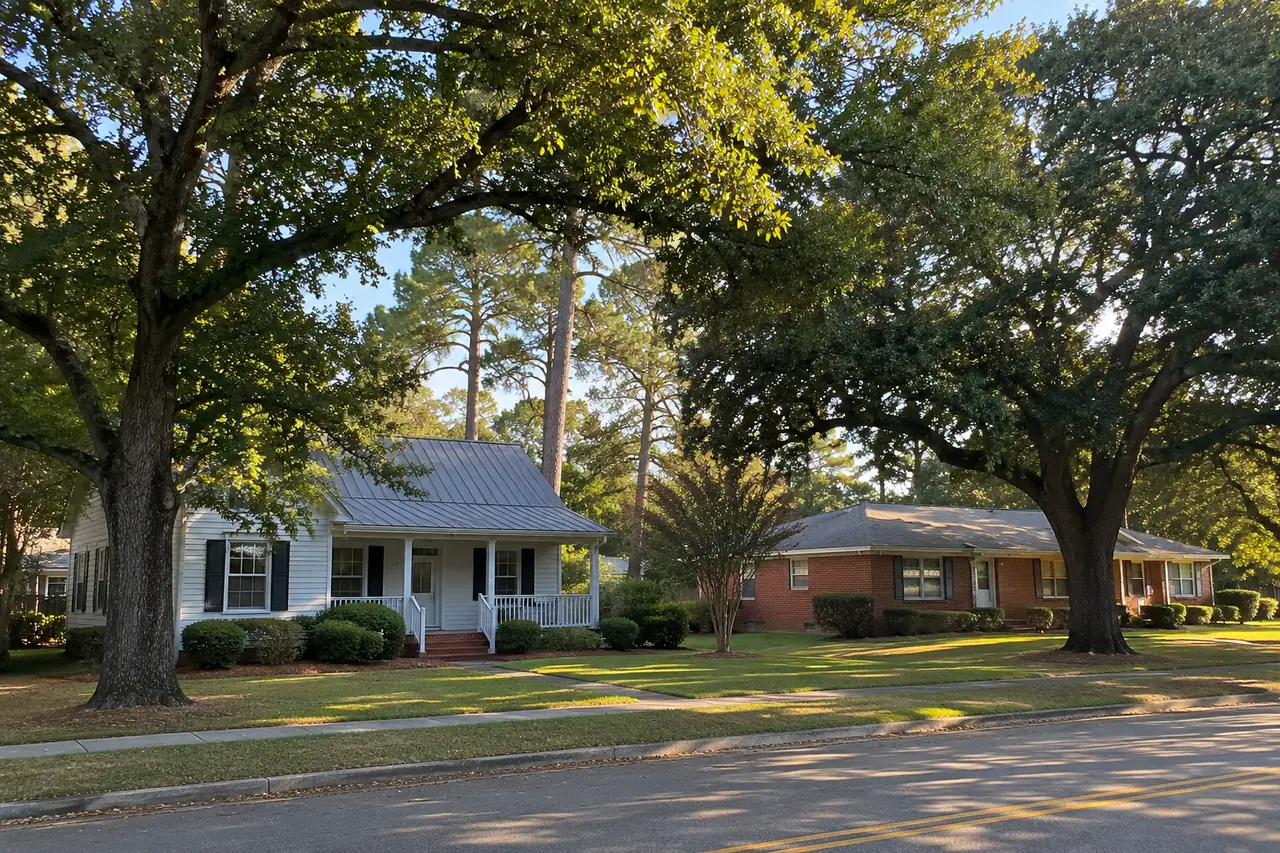
Yes. The city's Landscape Requirements page talks about new development, which can make the tree rule sound like it's only for builders. The ordinance itself is broader: Sec. 6-4.1(B) says the section applies to "all existing and new development," and then lists its exemptions (LMO Sec. 6-4; checked Nov 15, 2026). A lot that has had a house on it for fifty years is covered the same as one being cleared now.
What does the city require, tree by tree?
| Situation | What it takes | Where it's written |
|---|---|---|
| Pine, any size | No city tree permit | LMO Sec. 6-4.1(B)(2); fee schedule note; application header "Not Required for Removal of Pine Trees" |
| Dead or naturally fallen tree | Exempt | LMO Sec. 6-4.1(B)(1) |
| Tree the administrator finds a threat to public health, safety or welfare | Exempt, on the administrator's finding | LMO Sec. 6-4.1(B)(1) |
| Live non-pine tree below heritage size | $69.00 Tree Removal Permit; written reason and a sketch; staff measure and decide on replacement trees | Fee Schedule Resol. 2025-60; application revised 7/1/2025; LMO Sec. 6-4.2(B) |
| Heritage tree (non-pine, about 20 in. or more across; understory 10 in.) | Administrator's written approval, even to trim; two 4-inch caliper shade trees per removal, or public-land planting or a tree-fund payment if the lot has no room | LMO Sec. 1-13; 6-4.2(C)(1)(d)–(e); 6-4.2(C)(2) |
| Historic tree (non-pine, about 30 in. or more; understory 20 in.) | Same as heritage, but four replacement trees | LMO Sec. 1-13; 6-4.2(C)(1) |
| Work started before a needed permit | Permit amount doubles | Fee Schedule Resol. 2025-60, rule 6 |
| Violations | Stop work order possible; under city code Sec. 1-10, a fine up to $500, up to 30 days in jail, or both, each day a separate offense | LMO Article 10, Sec. 10-6.1(B) and (E) |
Which trees and situations are exempt?
Sec. 6-4.1(B) lists five kinds of exemptions (revised through 8/19/2025; checked Nov 15, 2026):
- Dead, fallen or dangerous trees: "The removal of dead or naturally fallen trees," and trees the administrator finds to be "a threat to the public health, safety, or welfare."
- Pines: "The removal of pine trees," "provided the minimum requirements of this section are maintained."
- Sight lines and surveys: selective removal to keep clear visibility at driveways and intersections, or for authorized field survey work.
- Utility easements: selective clearing to keep an easement working.
- Working land: land zoned or used for agriculture or forestry (including tree farms), nurseries and garden centers, or M-2 industrial use. Land substantially cleared under forestry gets no development applications for 36 months afterward.
The pine exemption shows up three times in the city's paperwork (all checked Nov 15, 2026). Besides the code, the fee schedule notes that "Homeowners/residential owners are exempt from permit requirements for the removal of pines," and the permit application is headed "Not Required for Removal of Pine Trees." The code's condition about "minimum requirements" ties back to the lot's minimum tree count (below); as read on Nov 15, 2026, neither Sec. 6-4 nor the permit application says how staff apply it to a pine-only removal, so a lot that's mostly pines is worth a call first.
As of Nov 15, 2026, Sec. 6-4.1(B) has no separate storm exemption: trees that fell on their own are covered by the first exemption, and a live tree left leaning or split but still standing isn't named, unless the administrator finds it a threat. Ask before cutting one.
What makes a tree heritage or historic?
Size, measured as diameter at breast height (DBH). Sec. 1-13 defines DBH as the trunk's diameter, measured to the outside of the bark, "4.5 feet above the ground" on the uphill side. The tree section, Sec. 6-4.2(C)(1), says "A heritage tree is any tree greater than 20 inches in diameter," and a historic tree is any tree greater than 30 inches. Sec. 1-13 sets lower marks for understory and ornamental trees: 10 inches for heritage and 20 for historic. Pines aren't heritage or historic trees at any size; Sec. 6-4.2(C)(1) points to their shallow roots and narrow growth habit as a risk to life and property (Sec. 6-4 revised through 8/19/2025 and Sec. 1-13 through 08/18/2026; checked Nov 15, 2026).
Two wrinkles. Sec. 1-13 words the sizes as "20 inches or more" and "30 inches or more," where Sec. 6-4.2(C)(1) says "greater than," so a tree right at the line is worth a question. And Sec. 1-13's definitions describe these trees as standing on public or private property "within a required setback," a condition the tree section doesn't repeat. As read on Nov 15, 2026, neither Sec. 1-13 nor Sec. 6-4.2(C) says how the city treats a big hardwood outside the setbacks, such as one in the middle of a back yard, so ask Community Development before cutting or trimming any large hardwood. To check yours, wrap a tape around the trunk at 4.5 feet and divide by 3.14; about 63 inches around is 20 inches across, and about 94 inches around is 30.
What the designation changes:
- Under Sec. 6-4.2(C)(1)(d), the tree can't be cut, removed, damaged, trimmed, sprayed or destroyed "without written approval by the administrator," and (e) has the administrator issuing permits "for trimming, removing or replacing heritage or historic trees."
- A removed heritage tree "shall be replaced with a minimum of two four-inch caliper shade trees"; a historic tree with "a minimum of four."
- Under (C)(2), if the lot has no room, the replacements can go on approved public property, or the owner can pay into the City of Perry tree fund instead. Community Development sets that amount.
How many trees does a Perry house lot have to keep?
Sec. 6-4.2(B)(2) says single-family and two-family lots must provide or maintain "one shade tree for each 3,000 square feet of lot area," with the building footprint left out, and an existing tree over 6 inches DBH that's kept counts as two trees. A shade tree, by Sec. 1-13, is one expected to grow taller than 35 feet with a crown spread over 30 feet. The permit application says staff use Sec. 6-4.2(B) to decide whether replacement trees are needed.
| Lot size | House footprint | Area counted | Shade trees' worth |
|---|---|---|---|
| 9,000 sq ft | 1,800 sq ft | 7,200 sq ft | About 2.4 (two kept trees over 6 in. count as four) |
| 15,000 sq ft | 2,400 sq ft | 12,600 sq ft | About 4.2 |
| 21,780 sq ft (half acre) | 2,600 sq ft | 19,180 sq ft | About 6.4 |
If a removal leaves the lot short of its number, expect staff to ask for replacements.
How do you apply?
- Get the form. Application for Tree Removal Permit (revised 7/1/2025) is on the city's Documents & Forms page.
- Write the reason and the timing. The form asks for a written statement of why you want the tree(s) removed and when you plan to remove them.
- Sketch the lot. Show "the location of all trees and the tree(s) you want to remove."
- Sign it. There are lines for the applicant and the "Property Owner/Authorized Agent."
- Submit it with $69.00. The Documents & Forms page says completed applications can be turned in at 741 Main Street; the city also runs an online Citizens Self Service portal, and attachments must be PDFs. Ask Community Development whether the tree permit can go through the portal.
- City staff visit. They measure the trees and decide whether replacements are required.
- Permit or plan. If no replacements are needed, the permit is issued. If they are, you're notified so you can prepare a replacement plan and schedule for the city to approve before the permit is issued, and staff inspect for compliance at the end of the agreed planting period.
What does it cost, and what doubles it?
The fee schedule amended by Resolution 2025-60, adopted October 21, 2025, lists "Tree Removal Permit $ 69.00/each." Its general rule 6 says "Any work started prior to obtaining a permit shall double the permit amount," which would make it $138.00 (checked Nov 15, 2026). As of Nov 15, 2026, that was the newest fee schedule this site found linked from the city's Community Development pages, but fees are reset by resolution from time to time, so confirm the amount when you apply.
What happens if trees come down without a permit?
Beyond the doubled fee, the LMO's enforcement article makes anyone who violates the chapter subject to the remedies and penalties it lists (Sec. 10-4). Those include "a stop work order" halting the work in violation (Sec. 10-6.1(B)), and "Criminal penalties shall be as provided by city code section 1-10" (Sec. 10-6.1(E)). That section sets a fine of up to $500, up to 30 days in jail, or both, and counts each day a violation continues as a separate offense (City Code Sec. 1-10). The tree section adds that trees injured or not protected to the city's standard "may be deemed ineligible," and additional trees "will be required" (Sec. 6-4.2(B)(6)). All checked Nov 15, 2026.
Which trees does Perry want planted back?
The city's administrative manual states a preference for native species, on the grounds that they suit local soils and climate. Its list of acceptable native shade trees includes live oak, willow oak, southern red oak, white oak, Shumard oak, overcup oak, red maple, river birch, sycamore, tulip poplar, blackgum, bald cypress, hackberry and green ash; for screens it lists eastern red cedar, southern magnolia, wax myrtle and yaupon holly (City of Perry Administrative Manual, Appendix "x"; checked Nov 15, 2026).
Its prohibited list, Table F, rules out ailanthus, black locust, box elder, "Callery Pear, Bradford Pear" (marked "Weak wood, invasive"), Carolina cherry laurel, chinaberry, female ginkgo, mimosa, mulberry, poplars, silver maple and Siberian elm. As of Nov 15, 2026, water oak and laurel oak aren't on the city's acceptable list, though they aren't on the prohibited list either.
How does Perry's rule line up with nearby places?
| Place | What this site found | Who to ask |
|---|---|---|
| City of Perry | Permit for live non-pines; pines and dead or fallen trees exempt (LMO Sec. 6-4.1(B)); heritage and historic rules | Community Development, (478) 988-2720 |
| Unincorporated Houston County (Bonaire, Kathleen, Elko) | County tree rules (Sec. 83.3; Sec. 83 adopted June 1, 2004) say they do not apply to privately owned property that's already developed | Houston County Planning & Zoning, 200 Carl Vinson Parkway, Warner Robins; (478) 542-2018 |
| City of Warner Robins | As of Nov 15, 2026, the city code (Secs. 2-226 to 2-237, Ord. 47-91) regulates trees on public land and in street rights-of-way; a search of the code found no permit for removing a tree on a private home lot. Owners must keep limbs over streets and sidewalks pruned to 10 feet of clearance and remove dead, diseased or dangerous trees that threaten the public (Sec. 2-235). | City of Warner Robins, 478-293-1000, to confirm for a specific lot |
| City of Centerville | As of Nov 15, 2026, city code Sec. 50-52 requires a permit from the city clerk's office only to plant, cut or remove a tree in a public street, parkway or other public place; a search of the code found no permit for removing a tree on a private home lot. Owners must trim limbs that block a street or sidewalk. | City of Centerville |
| City of Byron (Peach County) | As of Nov 15, 2026, a search of the city code found no permit for removing a tree on a private home lot. Sec. 16-89 requires the owner to promptly haul off a cut tree's trunks, logs, limbs and tops at the owner's expense, with no burning. | City of Byron |
More on each is on the Warner Robins page and the Houston County page.
Fine points of the Perry permit
Is the $69.00 per tree or per permit?
The fee schedule lists it as "$69.00/each." As read on Nov 15, 2026, neither the schedule nor the application says whether one permit covers several trees on the same lot, so ask when you apply.
Can the tree contractor apply for me?
The application has signature lines for the applicant and for the "Property Owner/Authorized Agent," so ask the contractor whether they handle the filing and whether the fee is in their price.
Can I take out a tree that blocks the view at my driveway?
Selective removal to keep clear sight lines at driveways and intersections is one of the code's exemptions (Sec. 6-4.1(B)(3); checked Nov 15, 2026). "Selective" is the key word; talk to Community Development before taking out a large hardwood on that basis.
Does a lot used for farming or timber fall under the rule?
Land zoned or used for agriculture or forestry, including tree farms, is exempt, but land substantially cleared under forestry can't get development applications for 36 months (Sec. 6-4.1(B)(5); checked Nov 15, 2026).
Once you know what the city needs, call (478) 777-5510 or send a request. One independent contractor in the Perry area takes it from there: a look at the tree, a price, and the work itself; ask them how they handle the permit if one is needed. Costs are on the cost page, and the job itself on the removal page.
Sources, all checked Nov 15, 2026, at perry-ga.gov unless noted:
- Land Management Ordinance Sec. 6-4 "Tree Protection" (standalone PDF revised through 8/19/2025; Article 6 PDF revised through 08/18/2026); Sec. 1-13 definitions and Article 10 enforcement (revised through 08/18/2026)
- City of Perry Fee Schedule, amended per Resol. 2025-60, adopted Oct 21, 2025
- Application for Tree Removal Permit, revised 7/1/2025; Documents & Forms page; Community Development page; Landscape Requirements page
- Administrative Manual, Appendix "x": Tree Protection; Landscaping, Buffering and Screening (acceptable and prohibited tree lists)
- Houston County Comprehensive Land Development Regulations Sec. 83 (houstoncountyga.gov); City of Centerville Code Sec. 50-52 and City of Byron Code Sec. 16-89 (Municode); City of Warner Robins Code of Ordinances, Chapter 2, Article VI, Division 4 "Tree Board," Secs. 2-226 to 2-237 (Municode); City of Perry Code of Ordinances Sec. 1-10, general penalty (Municode), and code enforcement page (wrga.gov)
Have a tree you want looked at?
Call or send the form. It goes to one independent contractor who works in Perry, Warner Robins and the rest of Houston County; they come see the tree, set the price and do the work.