
Storm Tree Cleanup in Perry, GA
Quick answer
If a storm puts a tree on your Perry, Georgia house, keep away from any line it touches, take pictures of everything, and get your insurer on the phone before cleanup starts; Georgia's insurance department says to report a claim promptly and not to get rid of damaged property until the adjuster has examined it (checked Nov 15, 2026). Houston County's record shows why it pays to know this ahead of time: an EF-3 with 160 mph winds tore through Bonaire on April 5, 2022, and an EF-0 on March 31, 2025 downed hundreds of trees from Centerville into north Warner Robins, many onto about 100 homes (NWS Peachtree City; checked Nov 15, 2026).
Which tornadoes have brought down Houston County trees?
These come from the National Weather Service office in Peachtree City, which covers Houston County and surveys the damage after each tornado (all checked Nov 15, 2026):
| Date and place | Rating, wind, path | What it did |
|---|---|---|
| April 1, 2016, about 7:42 to 7:52 a.m.: from half a mile northeast of Centerville to Robins Air Force Base | EF-1, peak 90 mph, 4.9 miles long, 350 yards wide | First trees down on Sentry Oaks Drive. Multiple large trees snapped or uprooted, some falling on houses; a large oak snapped at Duke Ave and North Sixth Street. A maintenance hangar near the base's Green Street gate lost big sections of metal roof. No deaths. |
| April 19, 2020, 11:25 to 11:26 a.m.: Elko Road, starting 1.1 miles south-southwest of Elko | EF-0, peak 80 mph, a quarter mile long, 50 yards wide | Scattered trees snapped or uprooted, mostly east of Elko Road. No injuries or deaths. |
| April 5, 2022, 3:49 to 3:56 p.m.: Bonaire | EF-3, peak 160 mph, 3.9 miles long, 820 yards wide | Destroyed two large high-tension power towers and one home, snapped a concrete power pole near its base, and tore roof sections and second-floor windows off houses. Trees snapped and uprooted; homes in Stathams Landing, especially along Fairways Drive, had minor to significant damage. One injury, no deaths. |
| March 31, 2025, starting 2:13 p.m.: Centerville into north Warner Robins | EF-0, peak 75 mph, 3.59 miles long | Downed hundreds of trees, many of which fell on about 100 homes and numerous vehicles. Some people were trapped; no injuries were reported. |
Local news coverage of the 2022 tornado (13WMAZ) put its touchdown near Bonaire Elementary School and followed it across the Ocmulgee River into Twiggs County. The 2025 figures come from the NWS survey update issued April 2, 2025.
What have hurricanes and wind storms done here?
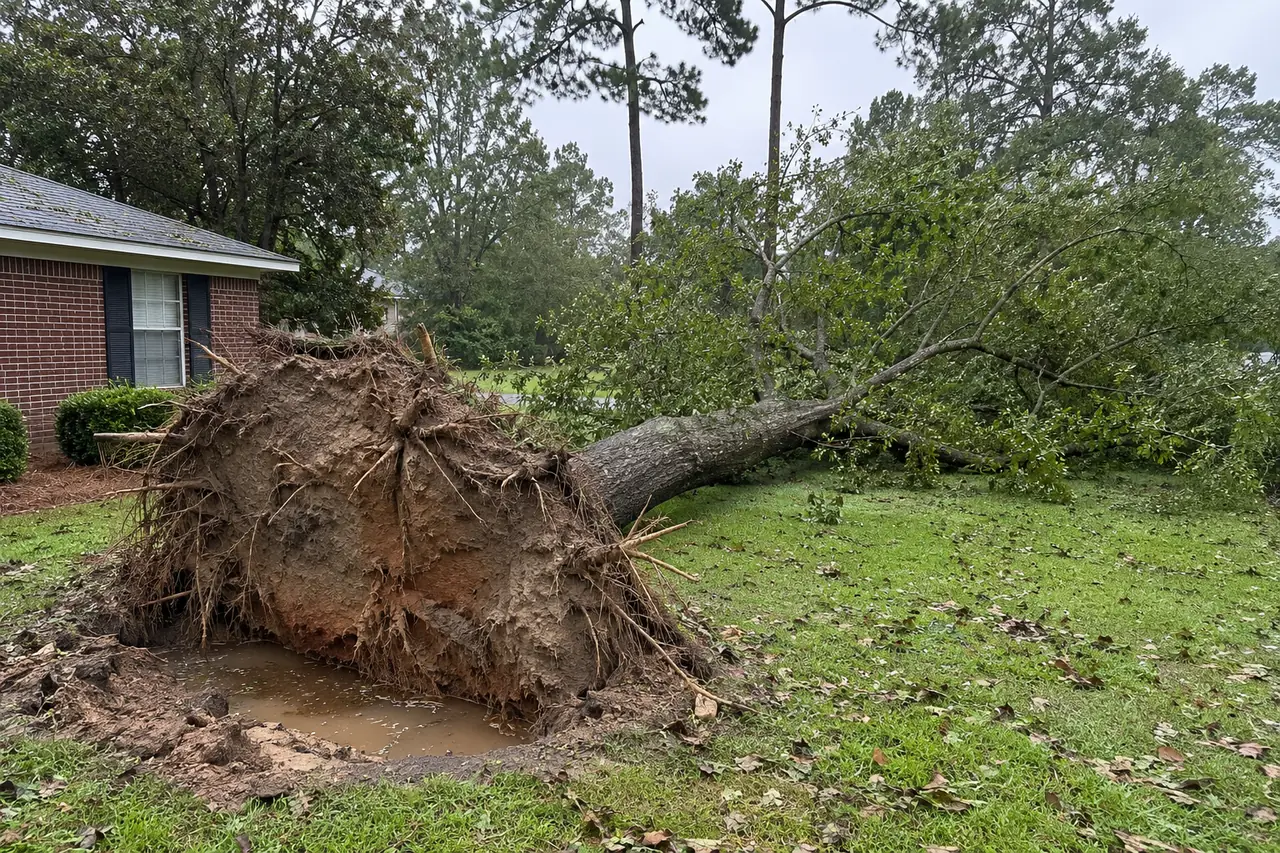
Hurricane Michael, October 2018. Michael crossed into southwest Georgia on the evening of October 10 still a Category 3. The NWS says gusts topped 70 mph in parts of central Georgia that evening, the highest official gust in its area was 76 mph at Arabi, "countless trees and power lines" came down, and power outages "lasted up to a week or even a bit longer for some areas" (NWS Peachtree City; checked Nov 15, 2026).
Hurricane Helene, September 2024. The federal storm record for Georgia describes gusts of 50 to 100 mph in parts of the state, 6 to 14 inches of rain, and millions of trees down (NCEI Storm Events; checked Nov 15, 2026).
January 9, 2024, straight-line wind. Preliminary reports to the NOAA Storm Prediction Center list a 68 mph gust measured at Robins Air Force Base, trees and power lines down in Perry, including on Marsha Dr at Gordon St, and across Warner Robins, including on Merlin St; a tree down on Green St at Northside Dr; and trees down on Thorndale Rd and Bargain Rd near Elberta (SPC preliminary storm reports; checked Nov 15, 2026).
FEMA's records list Houston County in these weather declarations (OpenFEMA, checked Nov 15, 2026):
| Declaration | Event | Declared | Programs for Houston County |
|---|---|---|---|
| EM-3642 | Severe winter storm | Jan 24, 2026 | Public Assistance |
| EM-3616 | Hurricane Helene (emergency declaration) | Sept 26, 2024 | Public Assistance |
| DR-4400 and EM-3406 | Hurricane Michael | Oct 14 and Oct 10, 2018 | Public Assistance only; no Individual Assistance (FEMA DR-4400 area list) |
| DR-4338 and EM-3387 | Hurricane Irma | Sept 15 and Sept 8, 2017 | Public Assistance only; no Individual Assistance |
| EM-3368 | Severe winter storm (ice storm) | Feb 11, 2014 | Public Assistance |
| DR-1858 | Severe storms and flooding | Sept 24, 2009 | Public Assistance, Hazard Mitigation |
| DR-1560 | Tropical Storm Frances | Sept 24, 2004 | Public Assistance, Hazard Mitigation |
| DR-1209 | Severe storms and flooding | Mar 11, 1998 | Individual and Public Assistance |
| DR-1033 | Tornadoes and flooding (Tropical Storm Alberto) | July 7, 1994 | Individual and Public Assistance |
Two points that often get mixed up. As of Nov 15, 2026, OpenFEMA's list of Houston County declarations includes Helene's emergency declaration (EM-3616) but not its major disaster declaration (DR-4830), whose designated-areas page reaches Houston County only through a statewide hazard mitigation line covering all of Georgia. The same list shows no declaration made in 2023, so Hurricane Idalia brought none here.
What should happen in the first hour after a tree comes down?
- Look up before you walk out. If any part of the tree is touching a line, stay away from it. Georgia Power says to contact it immediately if you see a fallen tree in contact with a power line. Flint Energies members can report outages at 888-354-6836 (georgiapower.com; flintenergies.com; checked Nov 15, 2026).
- Get people out of harm's way. Anyone injured or pinned? Dial 911 first.
- Photograph everything from several sides: the tree, the roof, the fence, the cars, the inside of any room it came into.
- Report the claim promptly to your insurance company, as the Georgia insurance department's disaster guide advises.
- Protect the house from more damage. The same guide says to make reasonable and necessary repairs, such as covering an opening, and to keep receipts for labor and materials.
- Keep the damaged things until the adjuster has looked at them.
- Don't sign with the first person who knocks. More on that below.
Will homeowners insurance pay for the tree?
That depends on what it hit and on your policy. The Georgia insurance department's disaster guide (checked Nov 15, 2026) explains that "If the tree does no damage to covered property, there is no coverage," so under that rule a tree that falls across the lawn without hitting anything covered is yours to clear. When a tree does damage the house or another covered structure, removal can be part of the claim, up to the policy's limit. Check your own policy for its debris-removal limit, and call the department's Consumer Services line at (404) 656-2070 with questions about a claim (oci.georgia.gov guide; checked Nov 15, 2026).
Two more points from the state's consumer office: "You should always talk to your insurance company before committing to any repairs," and "Be skeptical of any contractor that offers to pay your insurance deductible" (consumer.georgia.gov; checked Nov 15, 2026).
When it's a neighbor's tree, Georgia's general rule surprises people. The Attorney General's consumer education office says the owner of the property where the tree lands, not the tree's owner, is generally responsible for the damage and cleanup there. The tree's owner can be liable if they knew, or should have known, the tree was dead or diseased, for example from visible signs or written notice from a third party. And you don't have to clean up tree debris lying on your neighbor's property (Georgia AG Consumer Ed, Dec 1, 2022; UGA Extension C1099; checked Nov 15, 2026).
Which storm-hit trees look fine but won't make it?
UGA's storm specialists offer a few hard rules of thumb (UGA CAES, Apr 14, 2020; checked Nov 15, 2026):
- A medium or large tree that's been partly uprooted and leans severely, especially past 60 degrees, has little chance of surviving.
- A tree that lost more than a third of its bark rarely survives.
- Bradford pears are prone to split and can topple in wet, windy weather, while live oaks can stand up to stronger winds.
- Soaked ground is when trees go over: "When the ground is saturated and the soil becomes soft, trees are easily uprooted" (UGA CAES, July 21, 2017).
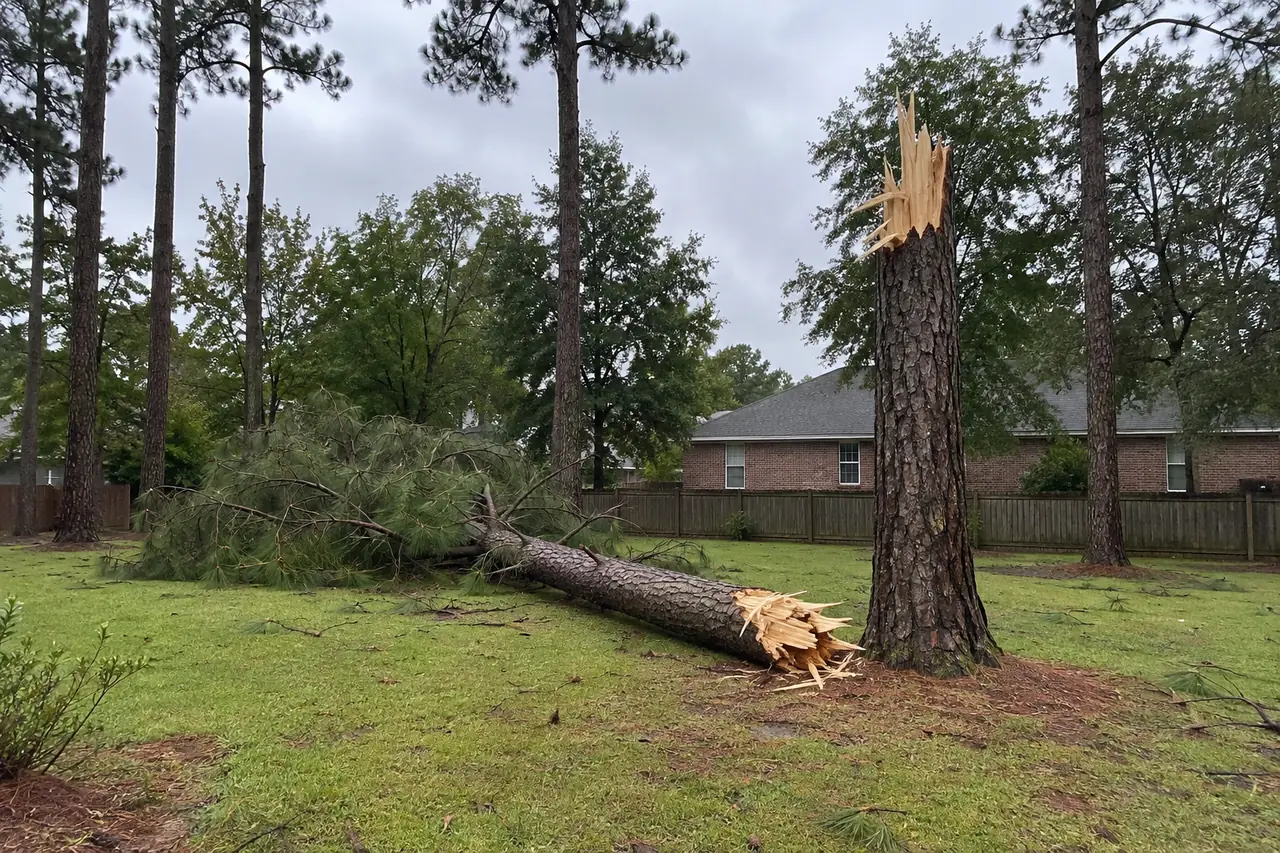
Storm-damaged pines carry an extra risk. The Georgia Forestry Commission says pine bark beetles strike trees weakened by storm damage, drought or saturated soils, and advises salvaging or removing damaged pines quickly. Its 2025 forest health report found that areas hit by Hurricane Helene "saw a sharp increase in Ips engraver beetles" (gatrees.org; USDA Forest Service Forest Health Highlights FY25; checked Nov 15, 2026). The dying pine page has the signs.
Inside Perry, the city's tree rule exempts trees that are dead or "naturally fallen," and trees the administrator finds to be a threat to public health, safety or welfare (LMO Sec. 6-4.1(B)(1); checked Nov 15, 2026). As read that day, it doesn't name a live hardwood left leaning but standing, so call Community Development at (478) 988-2720 before it comes down.
How do you spot a storm chaser?
Georgia's Consumer Protection Division, in its "Storms and Fraud" guidance, lists the habits that protect you after a storm (consumer.georgia.gov; checked Nov 15, 2026):
- "Avoid door-to-door offers for home repair work."
- "Never pay for the entire project before the work begins," and keep any down payment to no more than one-third of the total.
- Get every guarantee, warranty and promise in a written contract, with start and finish dates.
- Be wary of a contractor who only takes cash, a warning from the Attorney General and Insurance Commissioner's joint release after severe weather on May 6, 2022.
Georgia also added a cancellation right, effective July 1, 2025 (SB 201). When a contractor signs a contract with a homeowner within a year of a natural disaster to repair or mitigate damage to the home, the homeowner can cancel before midnight on the fifth business day after receiving written notice from the insurer that all or part of the claim isn't covered. The contractor must hand over a "NOTICE OF CANCELLATION" form before the contract is signed, and must substantially begin the work within a year (consumer.georgia.gov; checked Nov 15, 2026).
And when the Governor declares a state of emergency, Georgia's price gouging statute covers goods and services needed for recovery; during Helene, the Attorney General's office specifically warned about scammers charging "exorbitant prices for tree removal." Complaints go to the Consumer Protection Division at (404) 651-8600 or 1-800-869-1123 (consumer.georgia.gov, Sept 2024 alerts; checked Nov 15, 2026).
Where does the storm debris go?
- Perry: the city doesn't pick up yard debris produced by contractors doing tree removal or trimming; the contractor is responsible for removing it (City of Perry, checked Nov 15, 2026). The city code adds that public works collects trimmings from tree surgeons only after a natural disaster, and that a contractor's debris left in the right-of-way is removed by the city and billed to the property owner (Perry Code Sec. 22-25; checked Nov 15, 2026). Bulk piles should stay within six cubic yards (the city charges extra for bigger ones), set within two feet of the curb and three feet from other items, and bulk pickup won't take debris from work done by anyone but the resident or pieces over 75 pounds (City of Perry Solid Waste; checked Nov 15, 2026). Public Works: (478) 988-2732.
- Warner Robins: yard debris goes to the curb in piles no bigger than 5 by 10 feet for pickup every two weeks on trash day, residents can request a one-time collection for $25, and the city's hauler doesn't take yard waste left by a contractor (City of Warner Robins; GFL; checked Nov 15, 2026). Public Works: (478) 302-5554.
- Byron (Peach County): the city code requires the owner of a lot where trees are cut down to promptly remove all trunks, logs, limbs and tops at the owner's expense, and bars burning them or leaving them in a street, easement or right-of-way (Byron Code Sec. 16-89; checked Nov 15, 2026).
- Unincorporated Houston County: bulk pickup is scheduled through Ryland Environmental at 478-333-1722, 72 hours before your normal pickup day (Houston County solid waste page; checked Nov 15, 2026). County collection won't take material from work done or hired out to a professional contractor, limbs must be under 5 feet long, 8 inches across and 40 pounds, and a pile over 10 cubic yards doesn't qualify for curbside pickup (Houston County Code Sec. 50-41; checked Nov 15, 2026).
- Burning: the Georgia Forestry Commission says vegetative storm debris still needs its notification or a burn permit (1-800-GA-TREES), and Houston County is under the state's summer burn ban from May 1 through September 30 (gatrees.org; Georgia EPD; checked Nov 15, 2026).
Who else to call in Houston County after a big storm
Houston Emergency Management Agency (HEMA): Houston County Annex, 200 Carl Vinson Parkway, Warner Robins; 478-542-2026. HEMA's page points to Smart911 for alert sign-ups.
Flint Energies outages: 888-354-6836.
Georgia 811, before any stump is ground: 811 or 1-800-282-7411.
Georgia Consumer Protection Division: (404) 651-8600; 1-800-869-1123 in Georgia.
After-the-storm questions from Houston County
Does Perry's permit apply to a tree the storm knocked down?
No. Naturally fallen trees are exempt from Perry's tree rule (LMO Sec. 6-4.1(B)(1); checked Nov 15, 2026). Standing trees that are only damaged are the gray area; ask the city.
What does emergency tree removal cost?
National guides list emergency removal at up to $5,000 (This Old House; HomeAdvisor) or $150 to $250 an hour (HomeGuide), all checked Nov 15, 2026. The cost page has crane and hauling figures.
My neighbor's healthy tree fell on my fence. Who handles it?
Under Georgia's general rule, the damage on your side is usually yours and your insurer's to handle, unless the neighbor knew or should have known the tree was dead or diseased. See the claims section above.
Can I burn what the storm brought down?
Not between May 1 and September 30 in Houston County (Georgia EPD; checked Nov 15, 2026). Outside the ban, storm debris still needs the Georgia Forestry Commission's notification or permit, and inside Perry the city asks for a call to the fire department at (478) 338-6368 before any burning.
For storm work, call (478) 777-5510 or send a request. The request is routed to one independent contractor covering Perry, Warner Robins and the rest of Houston County, who assesses the damage, prices the cleanup and does it. The tree company guide covers what the written contract should say.
Sources, all checked Nov 15, 2026:
- NWS Peachtree City: April 1, 2016 and April 5–6, 2022 event pages; April 20, 2020 and April 2, 2025 public information statements; Hurricane Michael summary
- NOAA Storm Prediction Center preliminary reports for Jan 9, 2024; NCEI Storm Events, Hurricane Helene episode; 13WMAZ coverage of the 2022 Bonaire tornado
- OpenFEMA disaster declarations for Houston County; FEMA DR-4400, DR-4338, DR-4830 and DR-4738 designated-area pages
- Georgia insurance department, "Insurance Before and After a Disaster"; Georgia Attorney General Consumer Protection Division, Storms and Fraud and Helene alerts; Georgia AG Consumer Ed (Dec 1, 2022); UGA Extension C1099 and CAES storm articles
- Georgia Forestry Commission pine bark beetle and burn pages; USDA Forest Service, Georgia Forest Health Highlights FY25; Georgia EPD burn ban
- City of Perry Solid Waste page and LMO Sec. 6-4; City of Warner Robins and GFL yard waste pages; City of Byron Code Sec. 16-89, City of Perry Code Sec. 22-25 and Houston County Code Sec. 50-41 (Municode); Houston County solid waste and HEMA pages
Have a tree you want looked at?
Call or send the form. It goes to one independent contractor who works in Perry, Warner Robins and the rest of Houston County; they come see the tree, set the price and do the work.